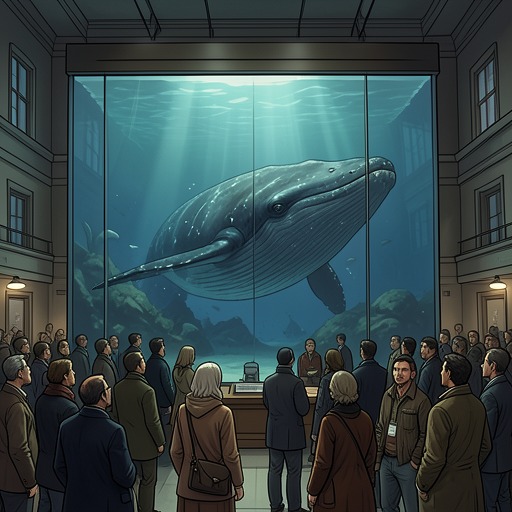
Royal Aquarium, Westminster
The WhaleRoyal Aquarium, Westminster, was a grand Gothic attraction opposite the Houses of Parliament and the final destination of a Beluga whale transported across the Atlantic for public display. Its 1877 exhibition joined Victorian curiosity about living marine animals to the ambitions of a new kind of public spectacle. The whale’s short life in its tank exposed the gulf between the promise of scientific learning and the conditions imposed by display: the animal was watched by crowds, examined after death, and made the subject of competing claims about knowledge and human responsibility.
An aquarium in the Victorian age
The arrival of the whale belonged to a wider fashion for bringing live marine animals before urban audiences. Reports of whales and other cetaceans in Southampton Water had already presented encounters with them as a source of public interest; aquaria in Manchester and Blackpool also received live animals. This appetite combined ingenuity with curiosity, but its attractions depended on moving animals far from their habitats and adapting them to unfamiliar enclosures. In that context, the Royal Aquarium’s Beluga whale was both an exhibit and a test of how much captivity could be made to resemble care.
The specimen was caught off Labrador with ten others after stranding at high tide. At nine feet and six inches long, it was smaller than the two Beluga whales Phineas T. Barnum had brought to his American Museum in 1861, but its journey to the aquarium was no less demanding. It travelled in a narrow box by sloop to Montreal and then by train to New York, a journey lasting two weeks. After seven months at the Summer Aquarium on Coney Island, it was removed from its tank and put aboard the North German Lloyd steamship Oder for Southampton. During the Atlantic crossing it was kept on deck in a rough wooden box lined with seaweed, wetted with salt water every three minutes, and was already living off its own blubber.
The journey and the tank
At Southampton, the whale was transferred to the South-Western Railway and carried on an open truck to Waterloo Station. Its new home was an iron tank forty-four feet long, twenty feet wide, and six feet deep. The scale of the enclosure could make the transfer appear to be a successful feat of accommodation, yet the animal’s arrival offered a stark measure of its confinement. It had been lying still in its box, breathing once every twenty-three seconds; when the box was moved, it flapped its tail feebly. It fell sideways into the water and sank to the bottom. After three hours without public visitors, it was presented to a large crowd from a specially built grandstand.
The Times questioned whether the conditions were suitable. The tank contained fresh water, and the whale was fed live eels, but observers noted that its high dorsal ridge stood sharply up rather than appearing rounded with fat. Noise or vibration from workmen could keep it submerged for as long as two minutes. The newspaper also considered what could be recovered from the animal if it died, noting that it would yield neither whalebone nor much blubber. That calculation made visible the competing ways the whale could be valued: as a living attraction, as an object of observation, and, after death, as a possible source of usable material.
Death and examination
The aquarium’s display ended in a violent collision with its own boundaries. The whale swam rapidly up and down the tank, struck its head against the wall, resumed circling, and collided with the end again. It then turned over and died. The account corrected an important detail of the public reporting: although observers had referred to the animal as male, it was female. Its death was followed by another exhibition, as the body was removed from the tank and shown to the public the next day. A plaster cast was made, and naturalists and physicians conducted a necropsy.
The examination found that the whale had a full stomach, complicating the expectation that it had simply starved. Its lungs were highly congested. The post-mortem account connected this condition to the Atlantic crossing: exposure on the open deck, together with repeated dousing, had caused rapid evaporation between soakings, and the animal had caught cold. The effort to keep it wet during transport had therefore not protected it from the conditions of the voyage. The cast and examination made the dead whale available for further inspection, but the knowledge gained came only after the living animal had failed to survive the journey and its confinement.
A dispute over spectacle and knowledge
The death prompted correspondence from prominent figures. Bishop Claughton of St Albans objected that a creature placed by its Creator in its own element should not be removed from it by human beings. William Flower of the Royal College of Surgeons, who attended the necropsy and later became the first director of the Natural History Museum, disputed the appearance of mistreatment: he attributed supposed marks on the whale’s body to eels nibbling its fins after death. Flower also defended the undertaking for the scientific and general knowledge it might provide. His position was not disinterested, since his institution received the internal organs for preparation and study.
The aquarium episode thus presents the public display not as a simple triumph of access to nature, but as a sequence in which transport, exhibition, death, and preservation all shaped what audiences could know about a whale. The Beluga was first offered as a living spectacle, then became a body examined and divided among forms of public and scientific interest. That transformation sharpened the central tension of the Victorian aquarium: curiosity could encourage attention to an animal, while the means used to satisfy it placed the animal’s life at risk.